
Decision support for mining operations
Mining decisions you can defend.
DeXMI reads your site’s plans, procedures and monitoring data, cites every source, and leaves the call with the risk owner.
Every decision, with DeXMI beside it
Faster, better-informed decisions. Still made by your risk owners.
Sooner
Answers, drafts and checks in minutes.
Better informed
Plan, regulation and readings side by side.
Consistent
Same starting point on every shift.
On the record
Reasoning kept for audits, handovers and inquiries.
Your risk owner decides
Drafts stay drafts until a named risk owner accepts them.
DeXMI Data Core
Your TARP, as a matrix the system can evaluate.
The code checks each trigger against the readings; each action can name its control owner. Each check shows which trigger was met and the reading behind it.
Screen from a test workspace with demo bands. Evaluation runs on demand today; scheduled alerting isn’t switched on.
See DeXMI Data Core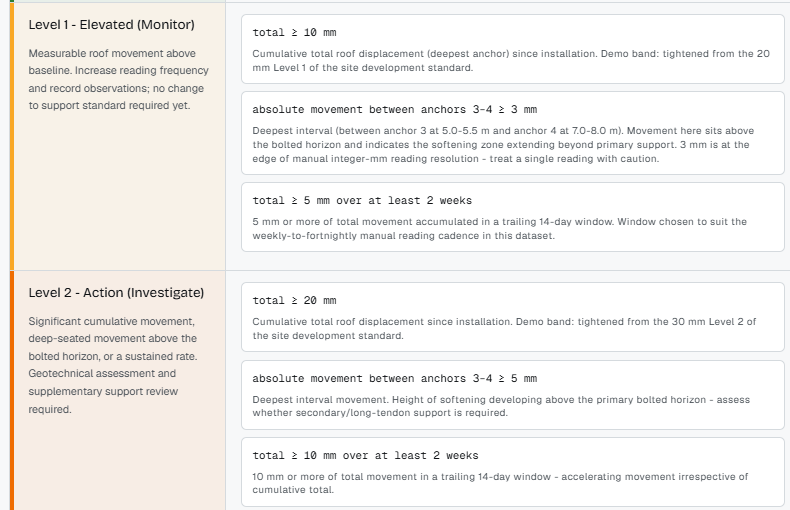
Analytical workflows
Any calculation your site repeats, locked in once and run by everyone.
Inputs, equations and checks defined once and run the same way every time, with every run logged; published to the company, and edited only by its author.
See analytical workflows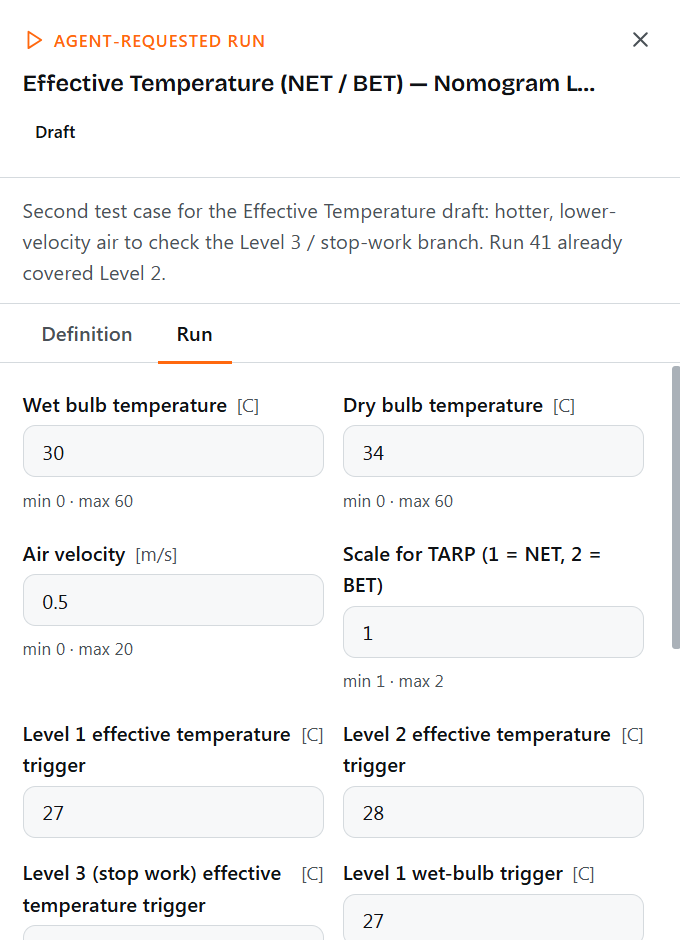
JSA · Risk assessments
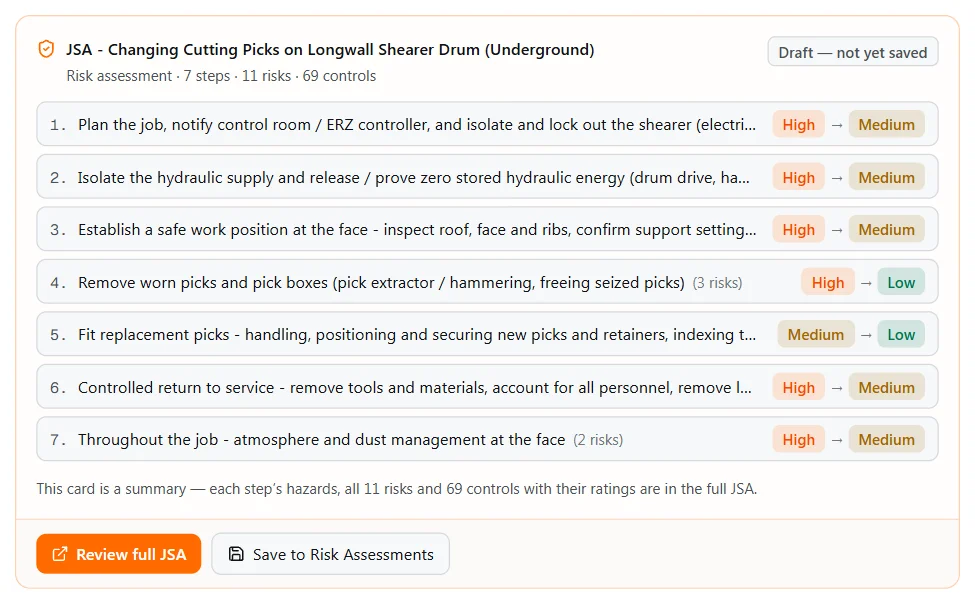
Risk assessments that carry your site’s memory.
Name the task and DeXMI drafts the JSA from a curated hazard register: steps, hazards, controls and ratings on a standard 5×5 matrix, with real incident notices attached where they match. The risk owner reviews, edits and signs it off.
- Never invented. Register risks and controls keep their register reference; on-site and AI additions are marked.
- Incidents attached. Matching incident notices print with the JSA, and saved JSAs are flagged when a new notice affects them.
- Run in the field. Crews tick off controls on a phone and sign by name; exports to the printed form or Excel.
- curated register risks
- 1,150+
- established controls
- 13,000+
- incident notices since 1999
- 600+
How a site starts
Three steps, and no site data until the agreement is signed.
Walkthrough
Thirty minutes on a representative site set. Bring a real question. We run it against that set in front of you and show every source and run.
Agreement
Site licence, data boundary and feedback-data terms signed before any site data enters DeXMI.
Managed onboarding
Our team sits side by side with yours during system configuration and onboarding.
Responsible AI, by construction
AI Transcribes. Code Computes. Humans Verify. Always.
DeXMI is an auditable agentic decision-intelligence platform that enables the responsible use of AI on a mine site. The output is a sourced, status-labelled record the risk owner can stand behind. Statutory obligations stay where the law puts them.
AI Transcribes
Each claim points to its document, section or record.
Code Computes
Each number comes from code, not the language model, and every run is logged.
Humans Verify
Your risk owners accept, amend or reject, and each decision is recorded.
Always
No exceptions. No number from a language model, no record final without a risk owner, on every job and every shift.
Modules
What runs today, and what is still a concept, each with its status.
- Concept
SHMS Intelligence
Your safety and health management system mapped as one knowledge graph: how documents, controls and obligations depend on each other, and what a change affects.
Read more - Live
Document Intelligence
Plans, procedures, reports and scans parsed properly, searched by meaning and exact term, and every answer cites the section it came from.
Read more - Live
Document Review
Contractor procedures checked obligation by obligation against your own standards, each graded with evidence from both documents.
Read more - Live
Risk assessments
JSAs drafted from a curated hazard register and incident notices, ratings computed in code. Review of existing assessments and controls next.
Read more - Live
Analytical Workflows
Any repeat calculation defined once, run the same way every time and shared company-wide.
Read more - Beta
DeXMI Data Core
Tell-tale readings and ground support observations captured once; readings calculated the same way every time and checked against the TARP.
Read more
About us
Built by mining engineers.
Why DeXMI exists

Dr Jason Emery
PhD, RPEQ · Director, DeXMI Pty Ltd · Principal, Optimum Geotechnics
Built by engineers who spent years on the searching, drafting and checking. So people can spend their time on the decisions only they should make.



Optimum Geotechnics was accepted into the NVIDIA Inception program for its development of DeXMI.
Security
Your documents never train a model.
Your decision record is captured only under your agreement. Each company’s data is kept apart from every other company’s, with access set by your admins.
Read the trust centreQuestions buyers ask
Which mining operations is DeXMI for?
Any of them: underground or open cut, whatever the commodity, wherever you mine. DeXMI works from your site’s own plans, procedures and monitoring data, and each module page says what is live today.
Is this a chatbot over our documents?
No. It is a compound agentic system that produces a decision record you can defend. It is not a foundation model, and its calculations run in code, not in the language model.
Who carries the accountability?
Your risk owners. DeXMI drafts and checks; the person your site appoints as owner of the risk accepts, amends or rejects, and the record shows who and on what basis. Statutory obligations under your jurisdiction’s mining legislation are unchanged.
How does DeXMI fit our AI policy?
Most corporate AI policies and government guidance on AI adoption ask for the same four things: traceable sources, deterministic computation, human oversight and an audit trail. That is the motto. Every claim cites its source, every number comes from logged code, a named risk owner accepts or rejects the record, and each decision is logged with who made it. Our Responsible AI policy is shared with customers during the walkthrough.
Do you train AI models on our data?
Your documents are never used to train models, and the AI providers we use don’t train on them either. The decision record (who accepted, amended or rejected what, and on what basis) is captured only under the feedback-data terms in your agreement, and is never shared across companies.
Where is our data kept?
Customer data (the application, databases, files, search index and backups) is stored in AWS’s Sydney region. Search indexing and ranking, and web search where you switch it on, use specialised services in the United States; the trust centre lists each one.
How do we get started?
With a 30-minute walkthrough with a mining engineer, on a representative site set. Once the agreement is signed, we manage your onboarding: our team sits side by side with yours while the system is configured for your site.
Build it with us
Do you want to help shape the future of mining?
AI runs on what mining digs up: the copper, iron ore, aluminium, lithium and uranium behind every data centre and every model. Mining is also where AI will be held to the highest standard, because the decisions are safety-critical.
Who sets the rules it works by is not settled. We think it should be the people who keep mines safe, and we’re building DeXMI with them.
Every decision your risk owners accept, amend or reject on DeXMI goes on the record. That record is how mining eventually removes people from the hazard altogether: machines that act on the accumulated judgement of the people who kept operations safe, under the same verification, with the same people accountable. Elimination sits at the top of the hierarchy of controls. This is the path to it.